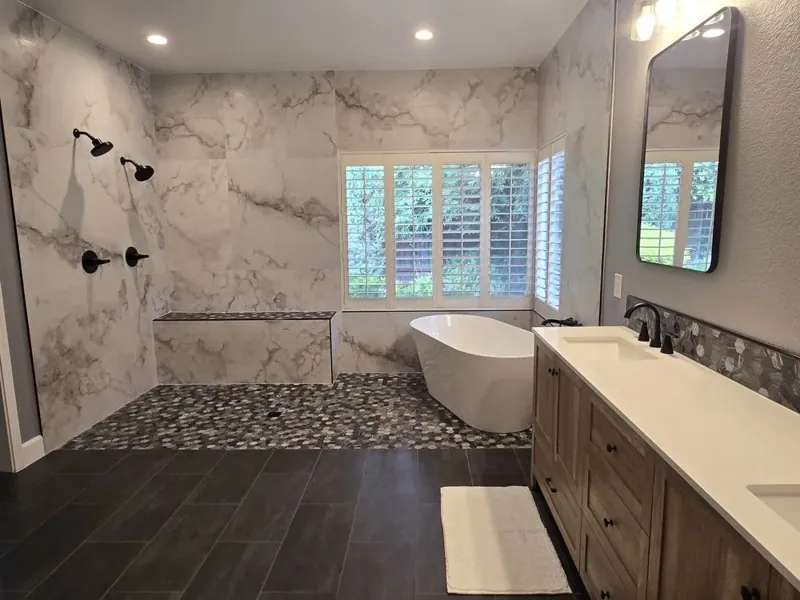
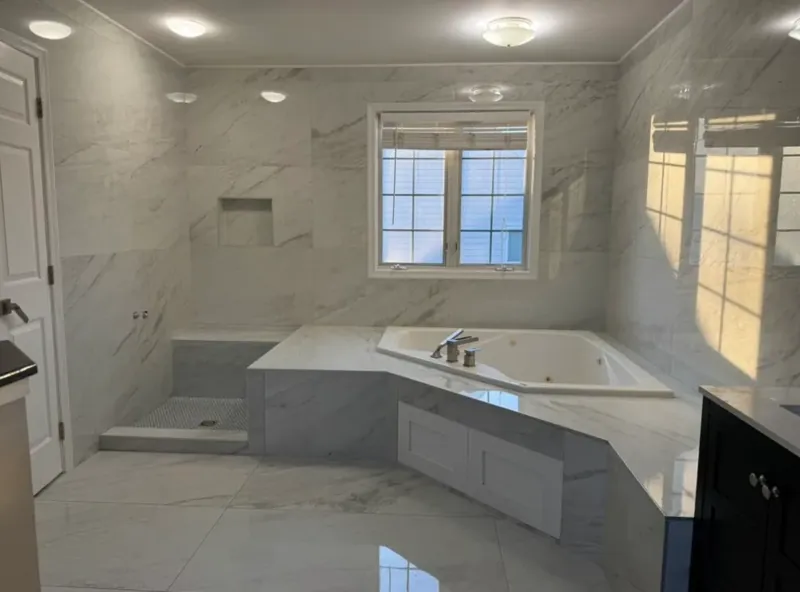
Commercial tile assemblies are made of several connected parts, and the right material depends on the whole assembly rather than on tile alone. Porcelain, ceramic, glass, quarry, and natural stone tiles each have different absorption, dimensional, surface, and maintenance characteristics. Large-format and thin tile can place additional demands on substrate flatness, handling, mortar coverage, and layout. We use the manufacturer’s requirements and the project conditions to guide product selection.
Substrate preparation may include compatible patching or leveling products, primers, cementitious backer materials, uncoupling or crack-isolation systems where appropriate, and movement-joint components. Adhesive and mortar selection should reflect the tile, substrate, exposure, coverage needs, and cure conditions. Mastic can be useful in limited interior applications, but it is not intended for wet or submerged areas and is not a substitute for a suitable mortar under every tile format.
Where an area is designed as a wet zone, waterproofing is a system detail—not a property automatically provided by tile or grout. Waterproofing may be relevant around showers, commercial wash areas, wet rooms, fountains, or other exposed locations, and must be coordinated at seams, corners, drains, penetrations, and changes of plane. Tile and grout can resist water in different ways, but neither should be treated as a complete waterproofing membrane. Natural stone may also need sealing, but sealing frequency and product choice vary by stone, finish, location, and manufacturer guidance; sealing does not make a stone installation waterproof.